


How a Professional Privacy Audit and Malware
July 25, 2026


Navigating the secondary mobile market in Canada requires clear risk mitigation, making post-purchase protection a top priority for consumers. When shifting away from volatile peer-to-peer marketplaces, understanding the precise legal and technical boundaries of retail warranties is crucial. In Canada, a reliable refurbished device should not rely on ambiguous promises; coverage must be backed by transparent, binding frameworks that align with provincial consumer protection acts.
This comprehensive guide breaks down exactly what is covered under standard Canadian protection windows, isolating internal component-level failures like logic board faults and charging IC degradation from everyday wear and tear. By pairing a secure warranty with an authoritative refurbished iPhone excellent condition guide, smart buyers can safely unlock premium flagship performance while completely eliminating the financial risks of undisclosed hardware anomalies.
Securing a pre-owned device in Canada demands more than just a functional checkout form; it requires a structured blueprint to guarantee long-term operational integrity. This comprehensive post-purchase framework establishes an authoritative standard for evaluating retailer accountability and provincial consumer protection laws across Canada. True peace of mind rests on explicit technical parameters, not vague sales guarantees.
We outline the crucial checkpoints every Canadian consumer must verify within the initial coverage window ranging from automated hardware diagnostics data access to clear return policies for delayed component anomalies like logic board failures or touchscreen desensitization. By aligning your purchase with these strict engineering and legal benchmarks, you effectively eliminate the financial vulnerabilities of the secondary market, transforming a simple phone upgrade into a fully secured, enterprise-grade technology investment.
The refurbished smartphone ecosystem in Canada operates under a patchwork of vendor policies and provincial consumer protection regulations. Unlike the brand-new retail market where warranties are highly standardized by original equipment manufacturers (OEMs), the pre-owned arena requires a discerning eye. To confidently decode this landscape, buyers must differentiate between limited merchant guarantees and comprehensive, multi-point certifications.
Understanding how a vendor handles structural and component-level coverage across provinces such as Alberta’s strict consumer protection frameworks is essential for true risk mitigation. By carefully evaluating these legal and technical baselines alongside a deep comparison ofCertified Pre-Owned vs. refurbished smartphones, Canadian shoppers can separate reliable retail operations from volatile, unverified secondary sellers, ensuring their financial capital is fully protected against unexpected hardware failures.
Every Canadian province has its own Consumer Protection Act designed to keep shoppers safe. These local laws create a strong legal safety net for anyone purchasing pre-owned electronics from a registered business. Even if a retail store has an “all sales final” or “no refunds” sign, provincial laws usually override those store policies if a device turns out to be defective right out of the gate.
Under these rules, any phone or tablet sold by a business must meet basic standards of use and quality. This means the device must work properly and last for a fair amount of time based on the price you paid for it. If a pre-owned smartphone suffers a major motherboard failure or screen glitch right after you buy it, these consumer rights allow you to demand a repair, a replacement, or a full refund through the store. These laws ensure that local retailers maintain high testing standards and sell truly reliable tech.
When securing a pre-owned smartphone, you will run into different types of coverage. Understanding how they work helps you choose the right device protection without overpaying:
Store Warranties: This coverage comes directly from the retailer where you bought the phone. It is usually included in the purchase price for a set time, like 90 days or one year. It specifically covers unexpected internal hardware faults, such as a failing charging port or a broken microphone, giving you direct access to on-site tech repairs.
Carrier Protection Plans: These are monthly add-on programs sold by major networks like Rogers, Telus, or Bell. Unlike a basic warranty, these plans cover physical accidents like cracked screens, water damage, or even a lost or stolen phone. However, they require a continuous monthly fee and a deductible which is an extra fee you pay out of pocket each time you make a claim.
AppleCare and AppleCare+: This is Apple’s official protection program. It stays attached to the specific serial number of the phone rather than the buyer. While it is rarely available on standard refurbished phones from third-party shops, if you buy a very new pre-owned device that still has active AppleCare, you get direct access to Apple phone repairs and genuine factory parts.
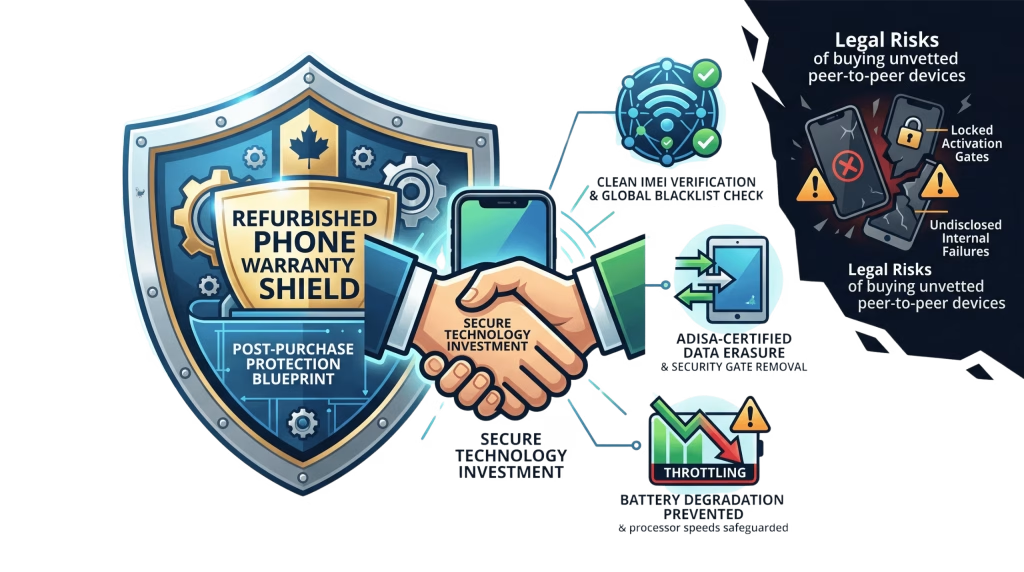
Choosing to buy a smartphone from an unverified private seller on online classifieds or local garage groups presents serious legal and financial dangers. Because these peer-to-peer sales are private transactions between individuals, provincial Consumer Protection Acts do not apply, leaving you with zero legal fallback if the deal goes wrong.
The primary risks of buying unvetted marketplace devices include:
The Blacklist Trap: A private seller might give you a perfectly working phone for cash, but report it lost or stolen to their insurance company a few days later. Once the carrier adds that phone’s unique identity number to the national blacklist, the phone is permanently blocked from all major Canadian networks, leaving you with an expensive paperweight.
Locked Activation Gates: Private sellers often forget or intentionally hide that a phone is still locked to a previous user’s personal iCloud account or a corporate security system. Without their exact password, you cannot bypass these activation locks, making it impossible to set up or use the phone.
Undisclosed Internal Failures: A phone might look great on the outside but have hidden water damage or a badly worn-out battery on the inside. Since private sales are strictly “as-is,” you have no way to get your money back once the cash changes hands, making local verified retailers a much safer choice for your wallet.
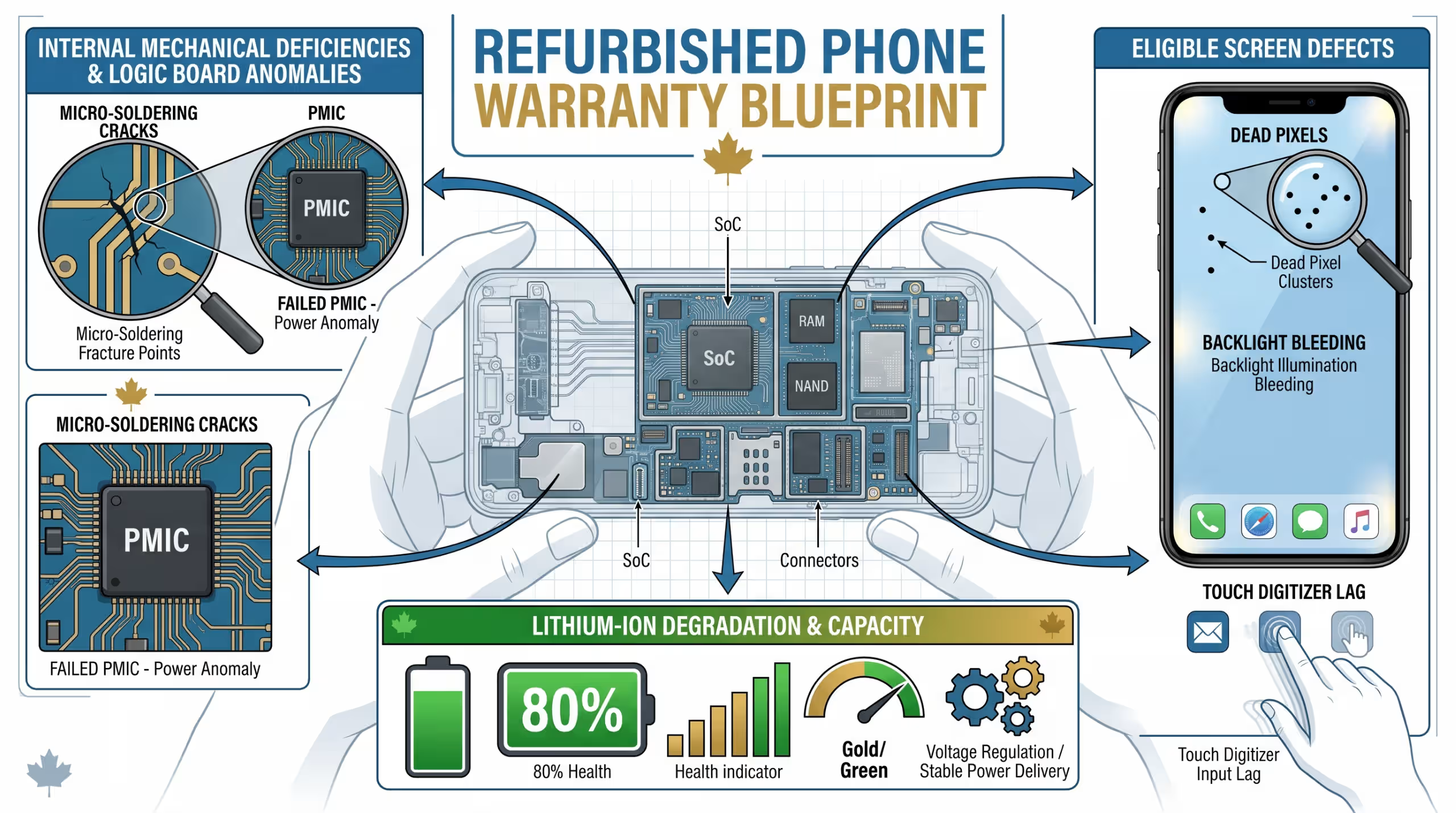
A comprehensive refurbished warranty is built upon rigorous component-level validation. Professional hardware diagnostics ensure that every vital system hidden beneath the smartphone’s chassis is thoroughly protected against premature operational failure. Standard protection frameworks prioritize the primary hardware layers of the device, ensuring the logic board architecture, micro-soldered power IC chips, and cellular radio bands remain completely stable.
Furthermore, trusted merchants protect critical user-interface modules, including the physical multi-touch digitizer and advanced biometric sensor arrays. Verifying these hidden core systems ensures that buying a pre-owned flagship over a new mid-range device delivers an elite user experience free from mechanical faults. True warranty protection isolates unexpected circuitry anomalies, ensuring your daily driver runs smoothly and reliably long after your purchase.
The logic board is the central circuit board, acting as the main “brain” of your smartphone. When a pre-owned device suffers from internal mechanical deficiencies, it usually means a micro-component on the main board is breaking down. A reputable store warranty explicitly protects you against these deep-level hardware anomalies because they are impossible to spot with a casual visual glance.
Common logic board issues covered by a standard protection plan include:
Power Management IC Failures: The integrated circuit (IC) chip handles energy distribution. If it fails, your phone might shut down randomly, drain its battery in an hour, or refuse to accept a charge even with a brand-new cable.
Micro-Soldering Fractures: Over time, old physical impacts can cause microscopic cracks in the solder joints on the board. This can cause the phone to suddenly lose its cellular baseband signal, drop Wi-Fi connections, or get stuck in an endless loop on the startup logo screen.
Thermal System Breakdown: The board fails to regulate heat properly, causing the phone to become dangerously hot during basic tasks like sending text messages or browsing web pages.
The display assembly is the most utilized component of any smartphone, making screen health a major focal point for warranty coverage. Standard retail warranties protect you from internal electronic defects, though they strictly exclude user-inflicted physical damage like cracks, deep fractures, or glass chips.
Here is how to identify eligible screen defects that qualify for a free retail repair or replacement:
Dead Pixels: Small, permanent black dots or bright colored specks on the display panel that never change color, indicating a permanent failure in the pixel grid.
Backlight Bleeding: Visible patches of uneven light leaking around the edges of the display screen, which ruins color accuracy and distorts contrast during video playback.
Touch Digitizer Lag: The internal touch-sensitive glass layer (the digitizer) stops responding accurately. This shows up as delayed responses, “ghost touches” where the phone types on its own, or complete dead zones where tapping the glass does nothing.
Clear sound transmission is essential for voice calls, audio messages, and daily media consumption. Because speakers and microphones rely on physical vibrations, they can wear out naturally over time. If your device experiences a sudden audio drop-off without any signs of water exposure or physical impact, it is fully eligible for coverage under a store warranty shield.
Watch out for these common audio defects during your post-purchase inspection window:
Blown Loudspeakers: Audio from the main bottom speaker sounds muffled, raspy, or makes a harsh buzzing noise at normal volumes, indicating the internal speaker cone has ruptured.
Degraded Earpiece Speakers: The top speaker used for standard voice calls sounds incredibly faint, forcing you to use speakerphone or headphones just to hear the other person.
Defective Microphone Arrays: Modern smartphones use multiple microphones to cancel out background noise. If one of these micro-components fails, the people you call will complain that your voice sounds distant, heavily distorted, or completely cut off.
Every smartphone relies on a lithium-ion cell that naturally breaks down over time. As a battery chemically ages, its ability to hold energy drops, which means less daily runtime for the user. A professional store warranty must include clear rules regarding how much capacity loss is acceptable before a battery is considered defective.
Unlike private sales where the battery health is completely hidden, verified retailers use diagnostic tools to check the cell before selling it. If you want to know how this plays out for premium Apple hardware, checking a detailed guide on ‘what does “excellent condition” actually mean’ for a refurbished iphone will show you how top-tier grading locks in a stable battery baseline. A trustworthy coverage policy ensures that if the battery degrades past a certain point during the warranty window, the merchant will replace it at no extra cost.
In the pre-owned phone market, 80% maximum capacity is the ultimate line in the sand. This specific number is not a guess; it is the universal benchmark set by hardware engineers to separate a healthy battery from a degraded one.
When navigating store policies, look for these specific guarantee details:
The Shipping Minimum: Reliable refurbishers promise that the phone will arrive at your door with a battery health score of 80% or higher.
The Voltage Protection: At 80% or above, the battery can easily handle major voltage spikes when you run heavy apps or play mobile games.
The Safety Floor: If the battery health is lower than 80%, the operating system will slow down the processor to stop the device from shutting down unexpectedly.
A charge cycle happens every time you use and recharge 100% of your battery’s power. Most phone batteries are built to last through 500 to 1,000 full cycles before their health drops significantly. When extreme usage or high heat speeds up this degradation process, it can trigger a valid warranty claim.
You can file a battery replacement claim under a store warranty if you notice these signs:
Sudden Capacity Dips: The maximum capacity percentage in your settings menu drops quickly over a short period of weeks instead of months.
Unexpected Power Offs: The device shuts down completely even though the screen shows you still have 20% or 30% power left.
Severe Performance Slowdowns: The phone software applies aggressive throttling, making your apps lag, your screen dim, and your typing feel slow because the battery cannot keep up.
Maintaining your retail warranty protection requires a clear understanding of the strict operational boundaries set by secondary-market merchants. While professional hardware guarantees offer massive risk mitigation against hidden logic board defects and component degradation, they are legally voided the moment a user introduces unapproved physical alterations.
To safely preserve your coverage, you must recognize what actions instantly trigger a protection denial. These technical boundaries apply across all device categories, whether you are protecting a premium device or tracking down budget cell phones. This section outlines the non-negotiable diagnostic red flags including unauthorized housing entry, unvetted repair attempts, and liquid contact indicator breaches that instantly strip away your store warranty shield. Recognizing these pitfalls ensures you stay perfectly aligned with local consumer protection guidelines while keeping your smart technology investment completely safe.
A store warranty is designed to shield you from internal factory defects, not external accidents. The moment a smartphone drops onto a hard surface, the resulting physical damage immediately voids your coverage. Even when hunting for the Best Budget Cell Phones, you must treat the device with care. Physical impacts cause structural fractures and micro-component damage that standard protection plans cannot cover.
Common examples of user-inflicted impact trauma include:
Cracked Display and Back Glass: Front screen or back glass shattering from a fall, drops, or deep pressure.
Bent Chassis or Frame: Warping of the outer aluminum, steel, or titanium housing, which puts dangerous pressure on the internal logic board.
Camera Lens Fractures: Breaks or deep scratches on the rear camera glass housing that blur your photos and expose internal sensors to dust.
Liquid damage is the ultimate deal-breaker for electronics warranties. Even if a phone originally shipped with a high water-resistance rating from the manufacturer, pre-owned devices have undergone previous lifecycles that naturally weaken their internal adhesive boundaries. When weighing your options between Certified Pre-Owned vs Refurbished Phones, you will find that neither tier guarantees absolute waterproof protection over time.
Here is why liquid damage instantly cancels your store protection:
Liquid Contact Indicators (LCIs): Technicians place small chemical stickers inside the phone’s chassis. If moisture touches them, they turn from white to bright pink or red, leaving un-erasable proof of liquid ingress.
Corrosion of Internal Circuitry: Liquid deposits minerals directly onto the micro-soldered components of the logic board, causing short circuits and sudden hardware failure weeks after the exposure.
Humidity and Steam Exposure: Using your phone in a hot shower can cause internal condensation, breaking the delicate electronic layers just as badly as dropping it in water.
If your pre-owned smartphone glitches during the warranty window, your first step should always be contacting the retailer who sold it to you. Taking the phone into your own hands or bringing it to an unauthorized mall kiosk for a quick fix will immediately destroy your protection blueprint. Retailers track the physical integrity of their stock using specialized internal markers.
Breaking these seals results in a permanent loss of coverage due to:
Ruined Adhesive Seals: Certified refurbishers apply a custom internal adhesive perimeter to keep out dust. Opening the housing tears this bond apart, proving the phone was disassembled.
Tamper-Evident Security Seals: Many local shops place microscopic security tape over the internal logic board screws. If a screw is turned, the sticker breaks, signaling unauthorized entry.
Risk of Hidden Component Damage: Unvetted technicians often lack the specialized static-safe tools required to handle delicate silicon boards, frequently causing static shock or torn ribbon cables during a blind disassembly.
Understanding the exact timeline for transaction reversals is a critical aspect of risk mitigation for pre-owned electronics buyers across Canada. Unlike hardware warranties that cover internal operational failures, buyer’s remorse clauses and satisfaction guarantees dictate your right to return a fully functional device simply because it does not meet your personal lifestyle preferences.
Canadian retail standards do not enforce a universal, nationwide return window; instead, return timelines are governed by individual vendor policies and specific provincial cooling-off guidelines. Navigating these return windows requires strict attention to detail, including monitoring restocking fee terms and device condition requirements. Mastering these transactional safeguards allows consumers to evaluate real-world device performance without facing financial exposure or un-refundable losses.
A true satisfaction guarantee gives you a trial period to test a pre-owned phone in your daily life. If the device does not fit your specific needs or lifestyle, you can return it within a certain window usually 14 to 30 days for a full refund or exchange. For instance, when searching for theBest Phones for Students on a Budget, a trial period is incredibly helpful to see if the battery can last through long school days or if the processing speed handles heavy multitasking without lag.
This structural safeguard removes the stress of purchasing pre-owned hardware online. It gives you the freedom to evaluate screen clarity, camera performance, and software features firsthand. If the device does not feel right in your hand, a hassle-free policy allows you to reverse the transaction easily, ensuring your hard-earned cash is never trapped in a device you do not love.
Before mailing back a device, you must review the merchant’s return policy to avoid unexpected out-of-pocket costs. Even if you are returning a premium device after comparing the iPhone 13 Pro vs iPhone 13 Pro Max, checking the small print prevents unwanted surprises. Pay close attention to these three core financial rules:
Restocking Fees: Some online refurbishers charge a flat fee or a percentage usually 10% to 15% to inspect and repackage a returned item. Look for local retailers that completely waive this fee for true, hassle-free returns.
Return Shipping Liabilities: Find out who pays for the return postage. Leading Canadian retailers will provide a free, pre-paid shipping label, while other vendors expect you to cover the mailing and tracking costs yourself.
Store Credit Policies: Check if the store will refund your original payment method, like your credit card, or if they only offer store credit. A transparent refund policy guarantees your money is returned directly to you if you are unsatisfied.
Before handing your smartphone over to a courier, you must follow strict digital cleanup protocols to ensure your data is safe and the store can process your return. Retailers cannot accept a device that is still locked to a personal profile. Follow these essential preparation steps:
Sign Out of Cloud Accounts: Log completely out of your Apple ID, iCloud, or Google profile. This automatically turns off security features like Find My iPhone, which completely blocks the store from testing the logic board.
Remove Lock Screen Passcodes: Disable your face recognition, fingerprint data, and lock screen PIN numbers so the store technicians can open the device instantly to verify its hardware.
Execute a Factory Reset: Go to your system settings and perform a full “Erase All Content and Settings” factory reset. This permanently clears your personal text messages, photos, and saved passwords, protecting your privacy and leaving a clean digital slate for the next user.
Navigating the secondary mobile market in Canada requires clear risk mitigation, making post-purchase protection a top priority for consumers. When shifting away from volatile peer-to-peer marketplaces, understanding the precise legal and technical boundaries of retail warranties is crucial. In Canada, a reliable refurbished device should not rely on ambiguous promises; coverage must be backed by transparent, binding frameworks that align with provincial consumer protection acts.
This comprehensive guide breaks down exactly what is covered under standard Canadian protection windows, isolating internal component-level failures like logic board faults and charging IC degradation from everyday wear and tear. By pairing a secure warranty with an authoritative refurbished iPhone excellent condition guide, smart buyers can safely unlock premium flagship performance while completely eliminating the financial risks of undisclosed hardware anomalies.
A certified 1-year retail warranty in Canada acts as a binding guarantee against spontaneous internal mechanical deficiencies and electronic failures. It specifically protects the core architecture hidden beneath the device’s chassis, including the main logic board, power management integrated circuits (ICs), micro-soldered components, and internal cellular antennas.
Additionally, it covers unexpected failures in critical user-interface modules, such as a desensitized touch digitizer, dead display pixels, or distorted audio arrays (including blown loudspeakers and microphone arrays), giving you immediate recourse to professional technical repair or replacement.
Navigating the Canadian pre-owned smartphone market requires a solid understanding of retail warranties and consumer rights. By demanding strict hardware diagnostics and robust store guarantees, you completely eliminate the financial risks of undisclosed defects or blacklisted devices. Ultimately, securing your technology investment through a certified local retailer ensures long-term operational integrity and true peace of mind, transforming your smartphone upgrade into a safe, sustainable choice.
Quick Questions!
A certified 1-year retail warranty in Canada acts as a binding guarantee against spontaneous internal mechanical deficiencies and electronic failures. It specifically protects the core architecture hidden beneath the device’s chassis, including the main logic board, power management integrated circuits (ICs), micro-soldered components, and internal cellular antennas.
Additionally, it covers unexpected failures in critical user-interface modules, such as a desensitized touch digitizer, dead display pixels, or distorted audio arrays (including blown loudspeakers and microphone arrays), giving you immediate recourse to professional technical repair or replacement.
Not strictly in a microscopic sense, but it guarantees a near-mint aesthetic baseline that is practically indistinguishable from a brand-new retail unit. As highlighted in our Refurbished iPhone Excellent Condition Guide, technicians evaluate cosmetic grading using the standardized 12-inch visual rule under a regulated 1,000-lux lighting setup, which replicates clear daylight.
To achieve a premium “Excellent” designation, the display glass, chassis perimeter, and camera housing must look completely free of visible dents, structural scuffs, or deep scratches when observed from one foot away. Any existing micro-abrasions must remain entirely imperceptible to the naked eye during standard daily use.
The 80% capacity metric is a non-negotiable benchmark established by electrical engineers and cell manufacturers based on the physics of lithium-ion chemistry. This floor represents the critical tipping point before significant electrochemical degradation occurs.
When a battery’s maximum capacity stays at 80% or above, its internal impedance remains low enough to easily sustain high-voltage power demands. If a cell drops below this percentage, it struggles to feed the powerful multi-core processor under peak workloads, forcing advanced operating systems to trigger dynamic performance management and aggressive processor throttling to avoid abrupt device shutdowns.
Established Canadian refurbishers bypass basic visual checks and instead deploy enterprise-grade automated multi-point inspection frameworks such as Phonecheck or Apkudo. These diagnostic software suites interface directly with the device’s internal operating system to programmatically execute over 60 functional health checks in a matter of minutes. This rigorous automated testing instantly validates component-level integrity, scanning the panel for hidden OLED burn-in, calibrating biometric sensor arrays (like Face ID infrared projectors or ultrasonic Touch ID mapping), confirming network radio band frequencies, and checking internal moisture sensors.
Yes, provided you purchase your device through a verified retail merchant rather than an unvetted peer-to-peer seller. While there is no single nationwide mandate for electronics satisfaction guarantees, reputable Canadian retailers back their inventory with a voluntary 14-to-30-day hassle-free return window.
This cooling-off period provides complete financial protection, giving you a real-world trial phase to evaluate performance metrics like battery endurance and software speed. To receive a full refund or exchange, you simply need to return the device in its original structural condition, remove all lock screen passcodes, sign completely out of personal iCloud or Google cloud accounts, and perform a factory reset.
No. Standard store warranties are strictly designed to mitigate the risks of manufacturing anomalies and component defects; they never extend to user-inflicted impact trauma or environmental exposure.
Accidental drops that cause structural fractures, shattered display panels, or cracked rear camera lenses instantly void your protection blueprint. Similarly, liquid damage is a definitive exclusion. Internal Liquid Contact Indicators (LCIs) turn bright red when exposed to moisture, giving hardware technicians immediate proof of internal liquid ingress which overrides and cancels any active store warranty shield.
The primary distinction lies in the rigor of the testing pipeline and the chain of ownership verification. “Refurbished” is a broad umbrella term that can apply to any pre-owned device that has undergone cosmetic cleaning or basic repairs, sometimes without strict quality control. Conversely, “Certified Pre-Owned” (CPO) signifies an enterprise-grade standard of verification.
A true CPO device must clear automated 60-point diagnostic software, pass international GSMA IMEI blacklist verification to ensure clean ownership, undergo ADISA-certified cryptographic data sanitization, and come backed by a documented corporate store warranty rather than an “as-is” private agreement.
If the device experiences accelerated cell degradation where the maximum capacity drops below the industry-standard 80% floor within your warranty protection window, a certified retailer will honor a replacement claim. True capacity coverage shields you from premature battery failures, unexpected power drops at 20% or 30%, and system slowdowns caused by a defective internal cell.
However, if advanced diagnostics reveal that the rapid drain is caused by user abuse such as extreme thermal stress from leaving the phone in a hot car or utilizing uncertified third-party chargers that damage the charging IC the claim may be denied under standard wear-and-tear exclusions.
To securely verify a device’s legal status, its unique 15-digit IMEI (International Mobile Equipment Identity) number must be cross-referenced against the Canadian Telecommunications Association (CTA) national blacklist database, often via Device Check Canada. This central registry tracks all handsets reported lost or stolen by major networks like Rogers, Telus, and Bell.
Certified local retailers automatically run these global database lookups before adding a phone to their inventory, completely de-risking your technology investment. Private peer-to-peer sales omit this verification, leaving buyers exposed to insurance scams where a seller blacklists the phone post-transaction.
No pre-owned smartphone should ever be treated as entirely waterproof, regardless of its original factory IP68 rating. To perform rigorous quality assurance, swap out degraded lithium-ion batteries, or inspect internal mechanical deficiencies, certified technicians must physically open the smartphone housing. This necessary process breaks the factory-applied, airtight liquid ingress seals. While professional refurbishers carefully reapply specialized industrial adhesives during reassembly to protect the circuitry against daily dust and minor splashes, the device is now water-resistant, not waterproof, and should never be submerged.
Not at all. Beginning with iOS 15.2, Apple’s firmware logs component replacements to keep track of hardware history. An “Unknown Part” notification simply means that a component, such as an optimized OLED panel or a high-capacity replacement battery, was installed by an independent service provider rather than an Apple Authorized center. In an elite device vetted by a professional Refurbished iPhone Excellent Condition Guide, this component has been thoroughly checked by automated diagnostic algorithms, functions identically to original factory hardware, and delivers maximum performance without affecting the phone’s operational life.
Yes, premium flagship smartphones boast extensive software longevity compared to budget mid-range models. Tier-one manufacturers engineer their pro-level devices with massive neural engines and advanced silicon architectures specifically designed to support long-term firmware updates. Generally, a flagship phone receives continuous, native operating system upgrades and critical security patches for 5 to 7 years from its initial launch date. Purchasing a 2-to-3-year-old pre-owned flagship ensures you remain protected with current software features and secure digital encryption for several years to come.

Director IT and Marketing
Based in Edmonton, Alberta, Dr. MD Samiul Islam is an Information Systems Consultant, Generative AI Specialist, and Machine Learning Engineer. Holding a Ph.D. in Computing Science from the University of Alberta, he specializes in model interpretability, responsible AI frameworks, and scalable MLOps architectures across Azure, AWS, and GCP. Dr. Islam designs production-grade AI pipelines and predictive analytics solutions using PyTorch, TensorFlow, and LangChain. His domain experience spans high-impact enterprise applications, including satellite crop mapping, hydrological flood modeling, and epidemiological data analytics.
July 25, 2026
July 24, 2026
July 23, 2026
July 22, 2026
July 9, 2026
July 9, 2026
Address: 15803 87 Ave NW, Edmonton, AB T5R 4G7, Canada
Phone: +1 587-444-5888
Support


To Grab The Offer, Fill The Form and Submit Now!