


How a Professional Privacy Audit and Malware
July 25, 2026


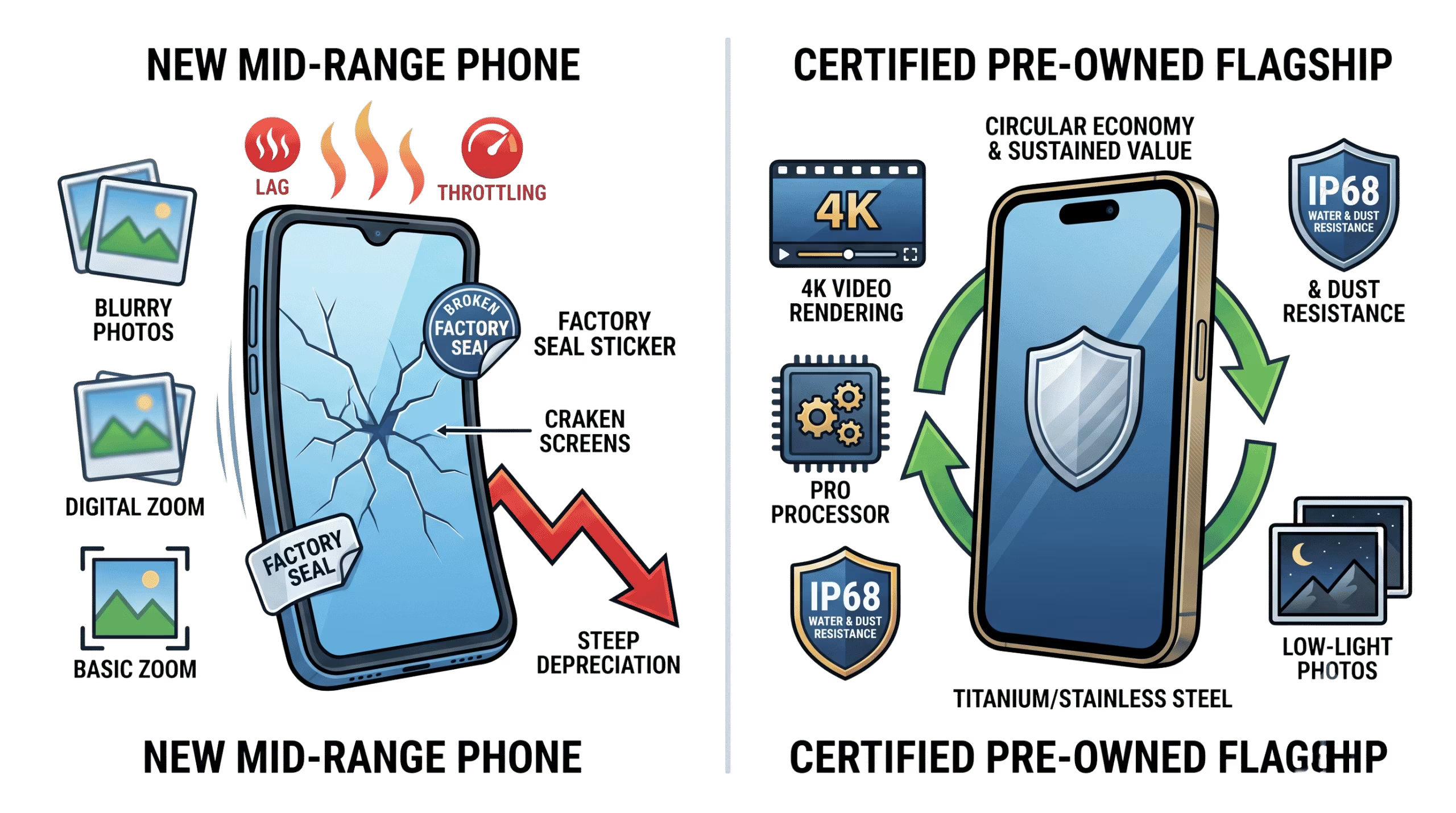
Are you caught between a brand-new mid-range smartphone and a matured, premium device? As macroeconomic pressures drive up tech prices, maximizing your price-to-performance ratio requires a strategic shift in consumer psychology. Many buyers assume a newly minted, mid-tier handset offers better hardware longevity, but mobile engineering tells a different story.
Paying full price for a device in cheap plastic means you give up on speed, heat control, and camera stability. Investing in a certified pre-owned powerhouse offers luxury quality. You get elite silicon optimization and top-notch display tech. Plus, you avoid steep retail depreciation.
Navigating comparative upgrades like the iPhone 14 Pro vs iPhone 14 Pro Max demonstrates that older top-tier generations retain immense operational efficiency. By prioritizing premium engineering over a marketing gimmick, savvy shoppers secure flagship performance while protecting their wallets.
The choice between a new mid-range phone and a refurbished premium device is fundamentally a battle of consumer psychology. Retail marketing masterfully exploits the “unboxing bias,” making shoppers overvalue a factory-sealed box while ignoring the rapid financial depreciation that immediately follows. To build a truly optimized upgrade strategy, you must analyze the lifetime asset value of mobile hardware.
Brand-new budget tiers experience an immediate drop in equity, yet their underlying computing architecture remains fundamentally limited. Conversely, choosing a certified pre-owned premium model represents high-level fiscal prudence. By decoupling your purchase from aggressive corporate launch cycles, you capitalize on the steep initial depreciation curve already absorbed by the first owner. This blueprint shifts your focus from superficial novelty to rigorous engineering value, ensuring you secure pro-grade processing speeds, advanced thermal efficiency, and superior material integrity at a fraction of standard retail costs.
The allure of tearing off factory plastic often blinds consumers to the underlying realities of mobile hardware longevity. This “brand new” illusion masks a critical industry truth entry-level and mid-range devices are manufactured with deliberate engineering compromises to minimize production costs.
To hit lower retail price thresholds, brands utilize inferior system-on-a-chip (SoC) architectures and less resilient internal components that quickly succumb to software bloating and silicon degradation. Authentic lifecycle value isn’t set by a release date. It’s based on key computing thresholds and the materials used in the structure. A certified flagship, made with top-quality parts, lasts much longer than new budget models. It keeps running smoothly and efficiently, while a cheaper mid-range option starts to lag in performance.
The thrill of tearing the plastic off a brand-new box is a powerful feeling. However, consumer psychology shows that this excitement fades very quickly when the product fails to deliver a smooth daily experience. Buying a brand-new mid-range phone often leads to buyer’s remorse within just a few months. Why? Because the “new phone” feeling cannot hide the fact that the internal computing power is already outdated. When apps begin to freeze, the camera struggles in low light, and the battery drains from simple tasks, the joy of unboxing is instantly replaced by frustration. You quickly realize you paid for the factory seal rather than actual hardware longevity.
To keep the retail price low, manufacturers build mid-range phones using cheaper materials. While they might look shiny on the store shelf, these entry-level components offer serious diminishing returns for your daily life.
Here is why budget hardware struggles over time compared to older premium devices:
Plastic Bodies Trap Heat: Unlike the aerospace-grade aluminum and titanium used in premium flagships, plastic frames do not cool down easily. When the phone gets hot from everyday use, the processor has to slow itself down (thermal throttling) to prevent damage, causing your apps to lag and stutter.
Fragile Screens: Mid-range phones rarely use top-tier glass, such as Apple’s Ceramic Shield or Gorilla Glass Victus. This means the screen is much more likely to suffer deep scratches or shatter entirely from a minor drop.
Slower Memory: Budget phones use cheaper, slower RAM and internal storage chips. This creates a data bottleneck, meaning it takes noticeably longer for your phone to load high-resolution photos, launch heavy apps, or switch smoothly between tasks.
When you buy a brand-new budget phone, its financial value drops like a rock the exact moment you leave the store. In the tech industry, this is known as a steep retail depreciation curve. While older premium flagships hold their financial worth exceptionally well, standard mid-range devices simply do not survive the resale market.
Massive Value Drops: Market tracking shows that while premium phones can often retain roughly 50% of their value after two years, standard Android budget models frequently lose over 70% of their initial resale value in that same timeframe.
Zero Trade-In Power: Major Canadian telecom providers and marketplace trade-in programs offer almost nothing for used mid-range phones. By the time you are ready to upgrade again in a year or two, your budget phone will not give you any meaningful financial credit toward your next purchase.
The Smarter Investment: Buying a certified pre-owned flagship means the original owner already absorbed that massive first-year price drop. You get a luxury phone that holds its value much longer in the Canadian marketplace, making it a far safer place to put your hard-earned money.
Behind every smooth user interface and rapid application launch is the underlying silicon architecture of the device. Smartphone manufacturers design flagship processors with vast multi-core compute capabilities, high-bandwidth memory pipelines, and advanced GPU optimization that mid-tier chipsets simply cannot replicate.
Even a two-year-old pro-grade System-on-a-Chip (SoC) operates on a vastly superior engineering tier compared to newly minted, cost-cut budget processors. A modern mid-range phone may have a high megapixel count or a catchy name. However, its limited data bus and poor thermal management lead to quick degradation during heavy software updates. Choosing an older premium flagship ensures strong performance. It offers fast processing, smooth multitasking, and stable operating systems. This reliability beats any new budget device.
The main engine behind any fast smartphone is its processor. When phone companies build top-tier “Pro” or “Ultra” models, they pack them with the absolute best chipsets available. These premium processors are built to handle massive amounts of work easily. Even when a flagship phone gets older, its processor remains incredibly strong.
On the other side, brand-new mid-range phones are forced to use weaker, budget-friendly chips to keep store prices low. While a new mid-range phone might feel fast for the first few weeks, it will quickly start to struggle as apps grow larger and software updates demand more power. An older premium processor is designed for the future, giving you smooth performance that lasts for years without annoying slowdowns.
When you look closely at how these chips are built, a new mid-range processor simply cannot match the multi-core design of an older flagship. To understand this gap, look at how Apple separates its phone lines in our comparison of the iPhone 15 vs iPhone 15 Pro. The Pro models always get advanced chipsets that process data much faster than standard or budget models.
Here is why older flagship chipsets beat brand-new mid-range chips:
Better Performance Cores: Flagship chipsets have larger, faster “brains” (called cores) specifically meant for heavy tasks like gaming, video editing, or loading large files. Mid-range chips use smaller, weaker cores that slow down under pressure.
Advanced Graphics Processing: Premium chips include custom graphics units that render images and videos smoothly. Budget chips often skip these high-end graphics components, leading to choppy screens and lag.
Long-Term Smart Systems: Flagship chips have built-in artificial intelligence tools that help the phone learn your habits, clean up system clutter, and keep your daily experience fast and fluid as the phone ages.
Two hidden factors that completely change how your phone runs every day are RAM (the phone’s short-term memory) and heat control. Flagship phones excel in both areas, ensuring your device never locks up or stutters during heavy multitasking.
RAM acts like a work desk. The more RAM allocation your phone has, the more apps you can keep open at the same time without the phone forcing them to restart. Premium phones use high-speed memory chips that allow you to instantly switch between a heavy mobile game, your camera, and your web browser without a single second of lag.
Furthermore, premium phones are built with advanced cooling systems made from metals like copper or titanium. When a phone chip works hard, it creates a lot of heat. If a phone cannot get rid of this heat which is a major problem for plastic mid-range phones the system will purposely slow itself down to cool off. This slowdown is called app throttling. Because older flagships handle heat perfectly, they prevent throttling entirely, keeping your phone running at top speed even during hot summer days.
Many new mid-range phones try to win over buyers by advertising massive numbers, like “108 megapixels.” However, a high megapixel count does not automatically mean you will get high-quality photos. The real secret to a beautiful picture is computational photography. This term simply refers to how a phone’s internal brain uses smart software to automatically balance colors, remove blur, and fix lighting the exact millisecond you press the shutter button.
Premium flagship phones have a highly advanced Image Signal Processor (ISP) built right into their main chip. This specialized hardware works alongside smart software to process millions of image details instantly. Because budget phones use weaker chips, they lack the raw power to run these complex photographic programs. As a result, their photos often look flat, muddy, or washed-out, proving that a smart phone brain matters much more than a big marketing number.
When you want to capture a crisp photo while walking, or zoom in on a faraway object, the physical parts inside the camera module make all the difference. Older flagship phones rely on premium, physical hardware to assist your photography, while new budget devices try to use cheap software shortcuts.
Here is why flagship hardware makes your daily photos noticeably better:
Optical Image Stabilization (OIS): Flagship cameras feature built-in OIS, which uses tiny physical springs and magnets to shift the actual camera lens inside the phone. This movement completely balances out your shaky hands, keeping your photos sharp and your videos perfectly smooth. Mid-range phones often skip OIS to save money, which is why their photos turn out blurry if your hand shakes even a tiny bit.
Dedicated Telephoto Lenses: Premium phones come equipped with a separate zoom lens (a telephoto lens) that uses real glass optics to magnify distant objects naturally without losing detail. Budget phones usually have only one main lens and rely on “digital zoom.” Digital zoom simply takes a standard photo, crops it down, and stretches it out, leaving you with a blurry, grainy, and pixelated mess.
Flagship Advantages in Advanced Low-Light Sensor Performance and Seamless 4K Video Rendering
Taking beautiful photos at night or shooting steady video is the ultimate test for any smartphone camera. This is where an older premium flagship completely outperforms a brand-new budget device.
The flagship advantage comes down to two major engineering factors:
Larger Physical Camera Sensors: For low-light photography, the size of the camera sensor and the physical chip that catches light is the most critical factor. Flagship phones use much larger sensors that act like a large window, letting in massive amounts of light even in dark rooms. Budget phones use tiny sensors that act like small peepholes, resulting in dark, grainy night photos full of digital noise.
Smooth 4K Video Rendering: Recording video in crisp 4K resolution requires an incredible amount of real-time processing power. Premium flagships render these massive video files effortlessly, keeping the frame rate perfectly stable. When a mid-range phone tries to shoot high-resolution video, its weaker processor quickly gets overwhelmed and overheats, causing your video to stutter, lag, or drop frames.
When investing in a smartphone, physical durability directly dictates its operational lifespan. The structural divide between a certified pre-owned flagship and a brand-new mid-range device lies in their foundational material integrity. To keep prices low, budget manufacturers use polycarbonate plastics for entry-level hardware. This material has weak tensile strength and traps heat inside, which speeds up battery wear.
Conversely, premium flagships utilize advanced engineering, incorporating heat-forged stainless steel, specialized glass, and aerospace-grade titanium. Examining the structural upgrades in a comparison like the iPhone 16 Pro Max vs iPhone 15 Pro Max highlights how these premium materials offer exceptional shock resistance and superior thermal dissipation. Buying a refurbished flagship secures a robust chassis built to survive daily drops while protecting critical internal components.
Why do flagship phones last so much longer in the real world? It all comes down to the high-quality materials used to build them. Premium devices use top-grade metals like titanium or stainless steel for their outer frames. These metals are incredibly strong, which stops the phone from bending, cracking, or denting when it slips out of your hand. On the other hand, budget phones use weak plastic frames that easily crack, warp, or scratch from everyday use.
When it comes to protecting your screen, the differences are even more obvious:
Ceramic Shield Glass: Premium phones use a special type of glass that mixes tiny ceramic crystals directly into the screen. This makes the display highly drop-resistant compared to the cheap glass used on budget models.
Shock-Absorbing Frames: Titanium and stainless steel act like a shield. They absorb the force of a hard fall and spread it across the frame, protecting the delicate computer parts inside. Plastic frames pass that shock directly to the inside, which can break the phone completely.
Long-Lasting Scratch Protection: The back glass on flagship models is treated with a matte or textured finish. This special coating resists scratches from keys or coins in your pocket and keeps ugly fingerprint smudges away.
The way a phone feels in your hand tells you a lot about its overall quality. When you pick up a refurbished Pro or Ultra model, it instantly feels solid, balanced, and expensive. Budget phones often feel light, hollow, and squeaky because their thin plastic backs flex when you press on them.
Because premium metals and glass do not break down, peel, or fade over time, a used flagship keeps its original luxury look and feel. The buttons stay crisp and clicky, the edges stay perfectly smooth, and the glass keeps its premium shine. This means you can enjoy a luxury device that looks brand new, without paying the high retail price.
Accidents happen to everyone, whether it is knocking a drink over onto your desk or getting caught in a sudden rainstorm. This is where advanced IP68 water and dust resistance acts as your ultimate financial safety net. The “IP68” rating is an official guarantee that the phone is tightly sealed against dirt and can survive being accidentally dropped into water without breaking.
To achieve this, flagship builders use custom rubber seals and strong waterproof glue around the buttons, speakers, and charging ports to lock moisture out. Most budget phones skip this expensive sealing process entirely to keep their costs low. By choosing a refurbished flagship that was engineered with a professional waterproof design, you protect your hard-earned money from sudden liquid damage and ensure your phone lasts for years.
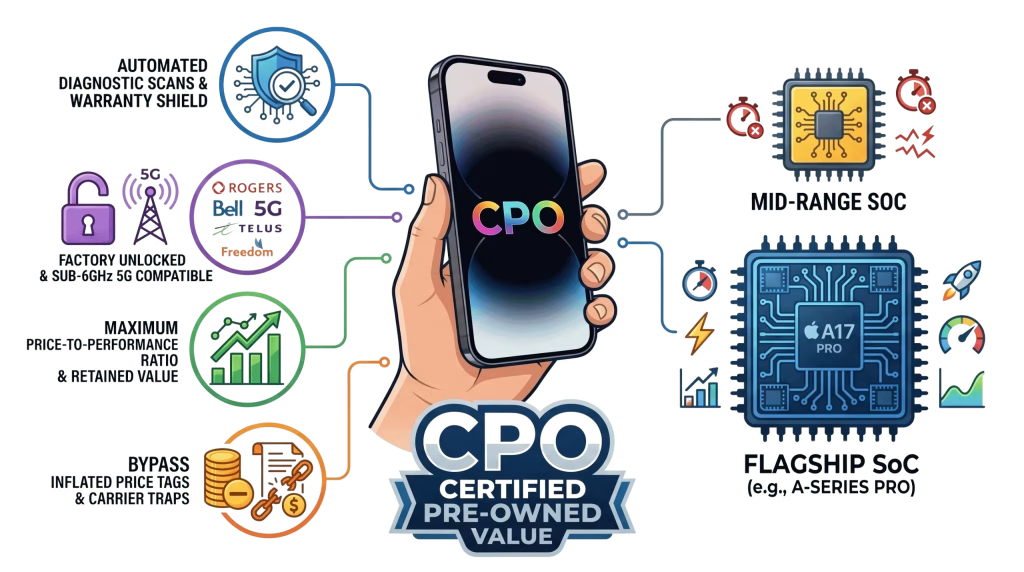
Unlocking the highest return on your technology investment requires a clear understanding of the secondary mobile market. Many shoppers mix up terms, but “Certified Pre-Owned” and “Refurbished Phones” are not the same. They have different testing standards and quality controls.
The certified pre-owned (CPO) system takes the guesswork out of buying used devices. It uses strict diagnostic scans, clear cosmetic grading, and verified store warranties. Instead of risking your hard-earned savings on an unvetted private marketplace, navigating an established retailer’s certified pipeline ensures your device undergoes comprehensive multi-point inspections. This operational transparency guarantees that the motherboard, cellular antennas, and battery health meet strict industry benchmarks. Knowing what “Excellent Condition” means for a refurbished iPhone helps buyers set realistic expectations. This clarity ensures top performance and gives peace of mind about their investment.
When you walk into a traditional carrier store, the goal of the salesperson is usually to lock you into a long-term contract. While walking away with a brand-new device for “zero dollars down” feels like a win, it is actually a financial trap. Carriers hide the inflated retail price of the phone inside your monthly bill, forcing you to overpay for the device over the next two or three years. If you decide you want to switch to a cheaper phone plan before the contract is up, you are hit with massive cancellation fees.
Buying a certified pre-owned phone breaks this cycle entirely. When you buy a used device outright, you skip the carrier financing trap and save hundreds of dollars right away. Because you own the phone completely, you are free to shop around for the cheapest monthly data plan, giving you total control over your monthly budget. For those searching for the Best Budget Cell Phones, buying a premium used model outright is the absolute smartest financial move.
A common worry when buying a pre-owned phone is whether it will work well with local networks. You might wonder if a refurbished phone will get the exact same signal as a brand-new one. The answer is yes, as long as it is fully unlocked and correctly tested.
When you purchase from a trusted Canadian retailer, they guarantee that the cellular antennas are factory unlocked. This means the phone is not tied to any single company and will instantly connect to Canada’s major networks, including Rogers, Bell, and Telus, as well as smaller brands like Freedom Mobile.
Most importantly, premium older flagships fully support Sub-6GHz 5G technology. This is the main type of 5G network used across Canada because it travels long distances and easily passes through building walls. By choosing a certified used flagship, you guarantee your phone will catch the fastest data speeds whether you are in a crowded downtown office or traveling through the suburbs.
The biggest fear of skipping the carrier store and buying a used phone is the worry that you might buy a “lemon” phone with hidden problems. This is exactly why you should never buy from unverified strangers on social media marketplaces. Instead, relying on a certified local retailer acts as your ultimate trust shield.
Certified retailers do not just look at a phone and guess if it works they use advanced technology to prove it. Here is how they protect you:
Automated Diagnostic Scans: Before a phone goes on the shelf, it is plugged into enterprise-level diagnostic software. This program checks every hidden part of the phone, ensuring the microphones, cameras, screen sensors, and Wi-Fi antennas work perfectly.
Battery Health Checks: The testing software also reads the internal battery data to guarantee it holds a strong, all-day charge, ensuring you will not need an expensive battery replacement anytime soon.
True Store Warranties: Unlike a private seller who disappears after taking your cash, a professional store gives you a written warranty. For complete coverage, review our comprehensive guide on understanding refurbished phone warranties in Canada so you know exactly what hardware vulnerabilities are protected post-purchase. If a hidden hardware issue pops up after you take the phone home, the store will repair or replace it for you.
This combination of deep software testing and real warranty support completely removes the risk of buying used. It allows you to enjoy flagship quality at a fraction of the price, with absolute peace of mind.
Choosing a certified pre-owned flagship over a plastic mid-range device is the ultimate blueprint for savvy consumers. By breaking free from the factory-sealed illusion, you secure elite computing power, aerospace-grade durability, and pro-level cameras without rapid retail depreciation. Do not compromise your daily experience on a bottlenecked budget handset.
Instead, explore our meticulously testedPre-Owned iPhones inventory at CellShoppe. Every device undergoes rigorous automated diagnostic scans and comes backed by a true store warranty, ensuring you unlock genuine luxury and sustained performance at a fraction of retail costs.
Quick Questions!
From an empirical hardware standpoint, a 2-year-old flagship consistently outperforms a brand-new mid-range device. Premium flagships are engineered with aerospace-grade materials, superior thermal dissipation architectures, and pro-level silicon designed to remain relevant for half a decade. Conversely, brand-new mid-tier phones achieve their low retail price through strategic compromises utilizing plastic chassis, omitting wireless charging, and relying on lower-binned processors. Investing in a pre-owned flagship maximizes your return on investment by securing top-tier computational speed and structural integrity at a depreciated price.
Rarely. The silicon architecture inside older “Pro” or “Ultra” models (such as an Apple A15 Bionic or Snapdragon 8 Gen 1) was designed with massive neural engines and high-frequency performance cores. Even after two years, these premium SoCs (System on Chips) generate higher multi-core benchmark scores than modern mid-range silicon (like the Snapdragon 6-series). This means older flagships can handle rapid, transient power demands like heavy multitasking and 4K video rendering without triggering the dynamic performance throttling often seen in newer budget processors.
Yes, and their support lifecycles are exceptionally robust. Manufacturers like Apple and Samsung build their premium devices with firmware longevity in mind, typically offering 5 to 7 years of guaranteed OS updates and cybersecurity patches. If you purchase a 2-year-old flagship, you are still secured for at least 3 to 4 more years of active logic board stability and software enhancements, matching or even exceeding the update roadmaps of modern budget electronics.
A refurbished flagship completely dominates in optical hardware. Budget phones often boast inflated megapixel counts (e.g., 108MP) but utilize tiny internal sensors and lack dedicated telephoto lenses, relying instead on noisy digital cropping. A premium 2-year-old flagship features massive physical sensor arrays, genuine optical image stabilization (OIS), and advanced computational photography algorithms. This translates to vastly superior low-light performance, authentic depth-of-field, and professional-grade video rendering that budget cameras simply cannot replicate.
A brand-new mid-range phone does possess a factory-fresh, 0-cycle lithium-ion cell. However, a refurbished flagship compensates through superior chip efficiency. As outlined in any professional Refurbished iPhone Excellent Condition Guide, top-tier refurbished devices undergo rigorous testing to guarantee a minimum battery health threshold of 80%. Because flagship processors manage electrical impedance and voltage regulation far better than budget chips, a refurbished flagship with 85% capacity can easily deliver the same genuine all-day endurance as a brand-new budget device.
Overheating is a direct result of inferior chassis materials and restricted thermal dissipation. Budget mid-range phones are predominantly constructed from polycarbonate plastics, which trap heat generated by the GPU during intense gaming loads. Older premium flagships utilize stainless steel or aluminum enclosures paired with internal vapor chamber cooling systems. This advanced physical housing efficiently pulls heat away from the logic board, preventing severe impedance spikes and ensuring stable, high-framerate rendering without thermal throttling.
Absolutely. Flagship devices manufactured from 2020 onward were the pioneers of advanced cellular radio basebands. A 2-year-old Pro model natively supports robust multi-band sub-6GHz 5G and LTE connectivity. When subjected to automated multi-point inspection frameworks, these devices are verified for strict carrier network alignment, ensuring seamless integration and uninterrupted signal retention across major Canadian telecoms like Rogers, Bell, Telus, and Freedom Mobile.
Yes, they are uniquely equipped to do so. Running localized artificial intelligence requires a dedicated Neural Processing Unit (NPU). Premium flagships historically dedicated massive portions of their silicon die space to machine learning operations. Therefore, an older Pro-tier device possesses the raw neural architecture required to execute real-time language translation, advanced biometric authentication, and generative photo editing much faster than the bottlenecked NPUs found in modern mid-range tech.
Significantly better. Budget devices experience a brutal retail depreciation curve, losing up to 50% of their financial value the moment you unbox them. A refurbished flagship has already absorbed this initial market depreciation. Because its premium materials (like Ceramic Shield glass and titanium/steel bands) resist structural degradation, it maintains a highly stable residual value. When you are ready to upgrade again, the premium pre-owned device will yield a much higher trade-in return.
While often used interchangeably by consumers, they have distinct supply chain meanings. “Refurbished” is an umbrella term for any repaired device, sometimes lacking strict quality control. “Certified Pre-Owned” (CPO) guarantees that the handset has passed an enterprise-grade automated multi-point inspection framework. CPO devices have cleared 60-point diagnostics verifying component-level integrity, passed GSMA blacklist IMEI checks, and undergone ADISA-certified cryptographic data erasure to guarantee a factory-fresh digital slate.
When sourced from an established, verified retailer, yes. A casual transaction on a peer-to-peer marketplace offers zero buyer recourse. However, as detailed in a comprehensive ‘Refurbished iPhone Excellent Condition Guide’, securing a device with a Grade A cosmetic benchmark from a reputable dealer includes a documented store warranty shield. This provides vital post-purchase protection against delayed hardware anomalies, such as logic board faults or charging IC failures.
No pre-owned mobile device should be treated as entirely waterproof, regardless of its original factory IP68 rating. To perform deep-level hardware diagnostics, internal component repairs, or battery cycle auditing, technicians must often open the physical housing. This process inherently breaks the original factory water-resistance seals. While certified refurbishment facilities apply industrial adhesives to protect against daily moisture and dust, the device is now water-resistant, not waterproof, and should never be fully submerged.

Director IT and Marketing
Based in Edmonton, Alberta, Dr. MD Samiul Islam is an Information Systems Consultant, Generative AI Specialist, and Machine Learning Engineer. Holding a Ph.D. in Computing Science from the University of Alberta, he specializes in model interpretability, responsible AI frameworks, and scalable MLOps architectures across Azure, AWS, and GCP. Dr. Islam designs production-grade AI pipelines and predictive analytics solutions using PyTorch, TensorFlow, and LangChain. His domain experience spans high-impact enterprise applications, including satellite crop mapping, hydrological flood modeling, and epidemiological data analytics.
July 25, 2026
July 24, 2026
July 23, 2026
July 22, 2026
July 9, 2026
July 9, 2026
Address: 15803 87 Ave NW, Edmonton, AB T5R 4G7, Canada
Phone: +1 587-444-5888
Support


To Grab The Offer, Fill The Form and Submit Now!